Ever wonder what grant of power the federal government uses as their authority to monitor, regulate, and control every aspect of an individual's life from the cradle to the grave? Answer: the Commerce Clause of the United States Constitution. Unbeknownst to most, virtually every US citizen has been issued a federal license to engage in interstate commerce. This license scheme began in November 1936 in order to give Congress free-reign under the umbrella of "regulating interstate commerce."
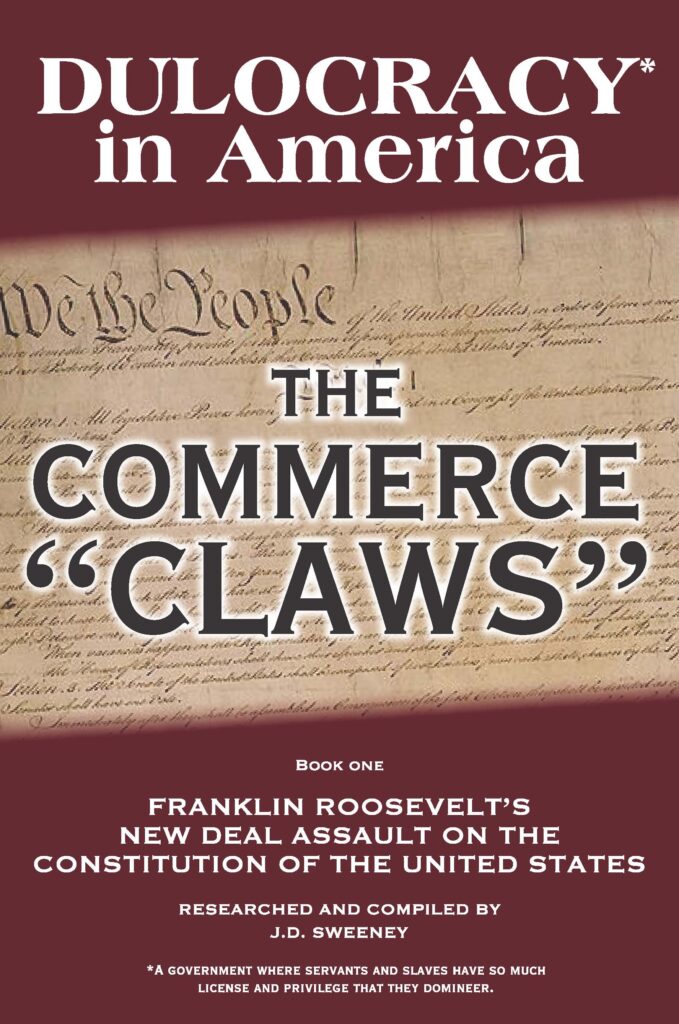
Dulocracy in America - The Commerce "Claws" exposes the true intent behind the New Deal legislation of President Franklin Delano Roosevelt. The book details the events that led Roosevelt to bring all persons" under the jurisdiction of the commerce clause. The evidence presented in this work conclusively prove the Social Security Number and the Federal Employer Identification Number are federal licenses to engage in interstate commerce and by virtue of the number the account holder is presumed to be a "person" who is engaged in congressionally controlled and regulated commerce.
Sweeney explains in detail how the Social Security Number is a federal license to engage in congressionally controlled interstate commerce. By using the number, the holder is presumed to be a "person" who is engaged in congressionally controlled and regulated interstate business. This license scheme began in November 1936 in order to give Congress free-reign under the umbrella of "regulating interstate commerce."
Thoroughly researched and documented, this work will stand as a standard and measure for other works on the origin of dulocracy in America. This work contains important legal references to the statutes and regulations that were passed and promulgated by the federal government during the Roosevelt era, along with historical records from government archives, legal writings of eminent constitutional scholars, newspaper articles from the 1930’s and court decisions adjudicating and construing the New Deal legislation and its relationships to the commerce clause of the Constitution.
This work has been painstakingly edited and compiled to present you - the reader - with “clear and convincing evidence” that the citizenry at large have effectively connected themselves with congressionally controlled privileges in exchange for what they perceived as promises of security from the cradle to the grave. The evidence presented in this work will prove beyond a reasonable doubt that the Federal Employer Identification Number (FEIN) and the Social Security Number (SSN) are federal licenses to engage in interstate commerce and by virtue of the number the account holder is presumed to be a "person" who is engaged in congressionally controlled and regulated commerce.
Excerpts from Dulocracy in America
Introduction
Security Number is Tattooed
Leon Roofener, 45-year-old building engineer for a Memphis theatre, is almost certain he will not lose his Social Security Act number. He has it tattooed on his left arm. Nashville Banner, January 13, 1937
“WE HAVE THEM NOW!” a smiling Franklin Delano Roosevelt told the Committee of Seven[1] in January, 1937 after being informed that 22 million federal licenses to engage in interstate commerce had been issued to employees across the United States. For four long years Roosevelt and his Brain Trust worked diligently to achieve the president’s vision of an all-powerful centralized government. The seedling that was planted in America’s political soil in 1933 had taken root and this tree was finally starting to bear fruit. Roosevelt’s fruit of dulocracy was ripe and ready for the harvest.
Dulocracy in America, Book One: The Commerce “Claws” is in no sense a biography of President Franklin Roosevelt. It rather sets out some of the legal history behind his New Deal legislation and how these programs were utilized in the United States, at both the state and federal levels. The story is one of subterfuge and apostasy. It illustrates how the opportunists in government have worked diligently to create a scheme for relieving an uninformed citizenry of their inherent and constitutionally secured rights, through a process that has been evolving for over one hundred years. In the first half of the twentieth century, the citizenry by clearly abandoning their individual responsibilities to their posterity, aided in the transformation of this nation from a constitutional democracy in republican form to a cleverly cloaked socialistic oligarchy.[2] What was conceived as a nation of confederated sovereign states united by and under the Constitution as the result of the direct and deliberate act of the duly authorized representatives of a once free and self-regulating People, metamorphosed into a collective endeavor pointed to the management of a large population under principles legally associated with mass peonage; the citizenry being converted into little more than commodities or resources, to be consumed and controlled for the purpose of promoting a socialistic concept of utopia founded on a hopelessly insolvent welfare state. The saddest part of the story is that the people, by active counter-revolutionary endeavor or by indolent acquiescence have, with the rarest exceptions, both promoted and enforced upon their neighbors, the values and norms of this usurpation system. In attempting to understand the relationships of the different materials presented in The Commerce “Claws,” it is important to understand the following:
Get a FREE complete second edition copy of Dulocracy in America - The Commerce "Claws."
Donate to continue the Research
Conclusion
A equilibrium of balance within the federal government itself has not always been obtained in our national history, but it is correct to say that with the exception of a state of war, there never has been heretofore such vast concentration of congressionally delegated power in the office of the Chief Executive as existed under Roosevelt's New Deal administration. In 1933, the justification for such a deposit of power was that the emergency nature of the times demanded it and that the Chief Executive himself, or his office, could with greater efficiency exercise or execute it. As in a state of war, the president is empowered by Congress to declare by public proclamation when this emergency status had ended. This has not yet been done, even seventy years after the so-called "great depression" ended, and the view now widely held in Congress is that the powers delegated to the Executive arm will be retained indefinitely, or until Congress itself reassumes the powers or repeals the statutes.
Under the Constitution, of course, there was no legal machinery to prevent this deposit of power by Congress, in the first instance, or to compel repeal of such legislation. The only possible constitutional remedy was for a private litigant in a proper case or controversy to question exercise of a given instance of such power, if he could prove special damage. This might be difficult to prove.[1] The recipients (a state or individual) of any benefit or federal funds would not challenge the source of power and even had they done so would not have been met by well established judicial doctrines of estoppel or waiver, as the case might be. Government by executive order or decree has been made possible under the vast powers thus entrusted to the president by a compliant Congress, thus substantially destroying, for the time, equilibrium of power within the federal framework. That Congress during the 1930's or even today may have been or may be motivated by laudable intentions does not validate it as constitutional.
[1] Ashwander doctrine.
Get a complete FREE second edition copy of Dulocracy in America - The Commerce "Claws."